

Hanna Instruments HI-83746 Photometer for determination of reducing sugars in Wine
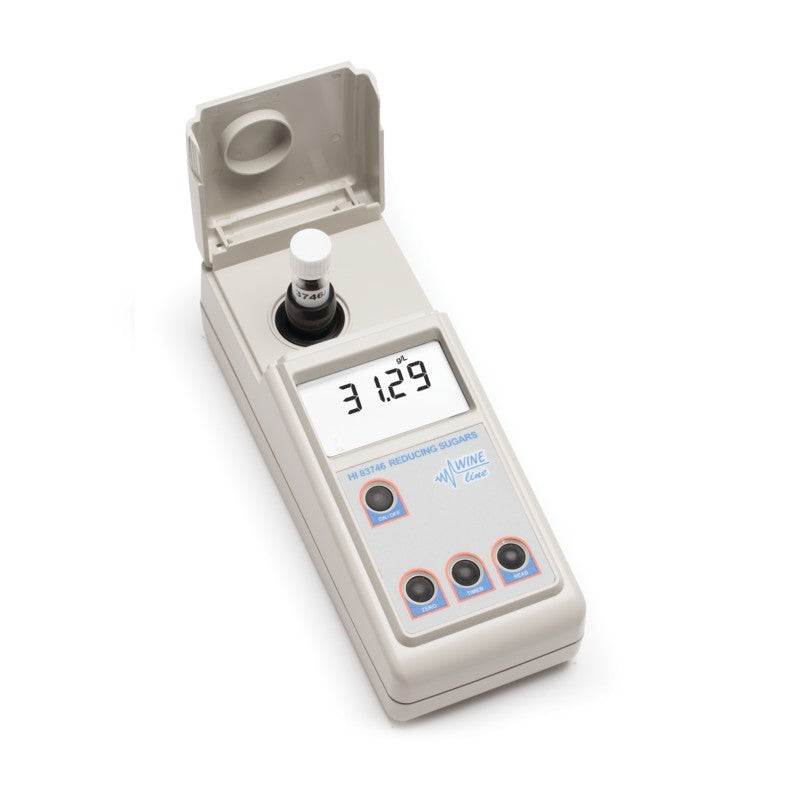
The HI-83746 photometer is for the determination of reducing sugars in wine. Hanna's photometers feature an advanced optical system; the combination of a special tungsten lamp, a narrow band interference filter, and silicon photodetector ensure accurate photometric readings every time. The exclusive cuvette locking system ensures that the cuvette is inserted into the measurement cell in the same position every time to maintain a consistent path length.
Built-in timer
Display of time remaining before a measurement is taken. Ensures that all readings are taken at the appropriate reaction intervals for the test being performed.
Zero key
A simple press of the zero key on the face of the meter will account for the colour and imperfections in the oil sample before reagent addition.
GLP
Review of the last calibration date.
Auto shut-off
Automatic shut-off after 15 minutes of non-use when the meter is in measurement mode. Prevents wastage of batteries in the event the meter is accidentally left on.
Battery status indicator
Indicates the amount of battery life left.
Error messages
Messages on display alerting to problems including no cap, high zero, and standard too low.
Units of measure
Appropriate unit of measure is displayed along with reading.
Typical content of reducing sugars in must and wine
| Must | ||
| sweet must | 20-25 % | 200-250 g/L |
| normal | 10-20 % | 100-200 g/L |
| in fermentation | 4-12.5 % | 40-125 g/L |
| Wine | ||
| sweet | 2.5-12.5 % | 25-125 g/L |
| semi sweet | 0.8-2.5 % | 8-25 g/L |
| almost dry | 0.2-0.8 % | 2-8 g/L |
| dry | 0-0.2 % | 0-2 g/L |
Significance of Use
Sugar is an essential component in the production of wine. During alcoholic fermentation, yeast consume sugars found in the grape juice, or must, and converts it to ethyl alcohol and carbon dioxide. In the case of certain styles of wine such as semi-sweet or dessert wines, some sugar is allowed to remain post-fermentation. This residual sugar can serve to provide a sweeter character to the final blend or play a role in microbial stability.
The primary fermentable sugars found in grapes are glucose and fructose. These two simple sugars are also known as reducing sugars because they contain functional groups capable of being oxidised under certain conditions. After reaction with excess alkaline cupric tartrate (Fehling reagents), the content of reducing sugars can be determined colorimetrically. The Fehling method is not an exact determination but an index of the reducing sugar concentration, because the reaction depends upon the amount and type of reducing sugars present. When the reducing sugar content is known at the beginning of fermentation, the potential alcohol degree can be estimated by multiplying the sugar concentration (in g/L) by 0.06.
Specifications
| Range | 0.00 to 50.00 g/L (ppt) |
| Resolution | 0.25 g/L |
| Accuracy | ±0.50 g/L ±5% of reading |
| Light Source | Tungsten lamp |
| Sensor | Silicon photocell with narrow band interference filter @ 610 nm |
| Method | Fehling |
| Environment | 0 to 50°C; max 95% RH non-condensing |
| Battery Type | (4) 1.5V AA batteries/12 VDC adapter |
| Auto Shut-off | After 15 minutes of non-use |
| Dimensions | 224 x 87 x 77 mm |
| Weight | 512 g |
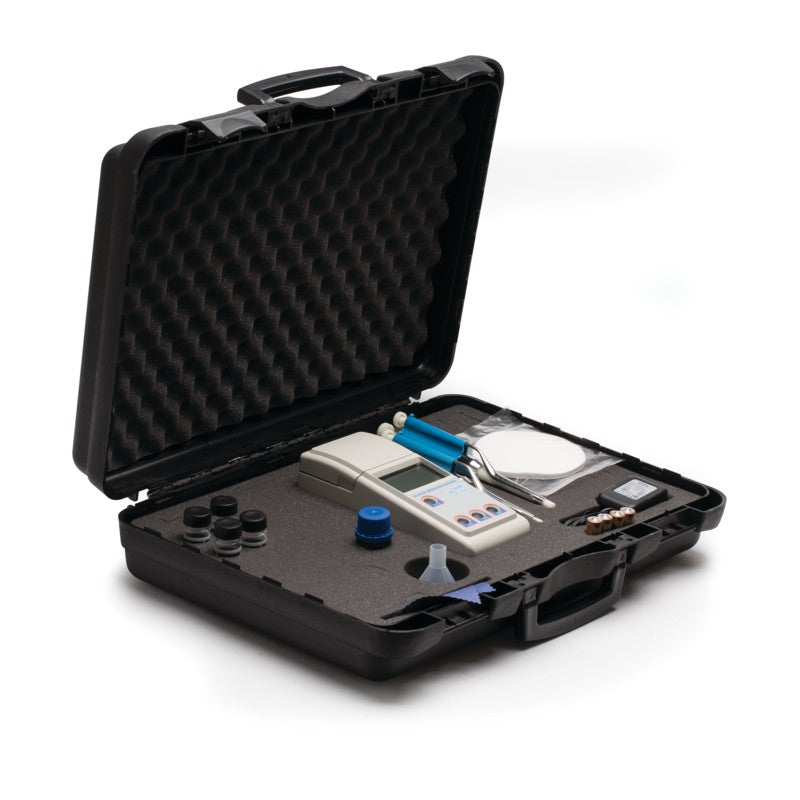
| Ordering Information | HI-83746-02 (230V) is supplied with glass cuvettes and caps (4), reagents for about 20 tests (HI-83746-20), HI-93703-59 Charcoal, 200μL, automatic pipette with two plastic tips, 1000 μL automatic pipette with plastic tips (2), instruction sheet for automatic pipette, spoon, funnel, filter paper (25), cuvette wiping cloth, 12 VDC adapter, batteries, instructions and Instrument quality certificate, rigid carrying case. |
| Optional Reagents | HI-83746-20 reducing sugar reagent set (20 tests); HI-93703-59 charcoal for decoloration of red wine (about 100 tests), HI-839800 COD test tube heater (required) |
Frequently Asked Questions
Clear answers to help you choose the right water testing solution with confidence
Which brands of water testing kits do you supply?
Do you provide kits for both home and professional use?
Yes — whether you’re a pool or spa owner, aquarium keeper, utility company, or a university laboratory, we have the right solution for your needs.
Can I arrange servicing or calibration for my photometer?
Absolutely. We also provide servicing and calibration to keep your photometers accurate and reliable.
How quickly do you dispatch orders?
Orders placed before 2:30 pm (Monday–Friday) are dispatched the same day. We also ship on Saturdays for your convenience.
Which couriers do you use for delivery?
We deliver through UPS, DPD, and Royal Mail. You can also choose to upgrade to next-day delivery at checkout.
What is your return policy?
We accept returns within 14 days of delivery provided the items are unused, in their original packaging, and in resalable condition. Please contact our team before returning any items.
Can I place bulk or business orders?
Yes, we welcome bulk, trade, and institutional orders. For tailored pricing or large quantities, please get in touch with us directly.
How can I get help if I’m unsure which kit to buy?
You can call us at 📞 +44 (0)115888 2726 and our team will guide you in choosing the most suitable kit for your needs.