

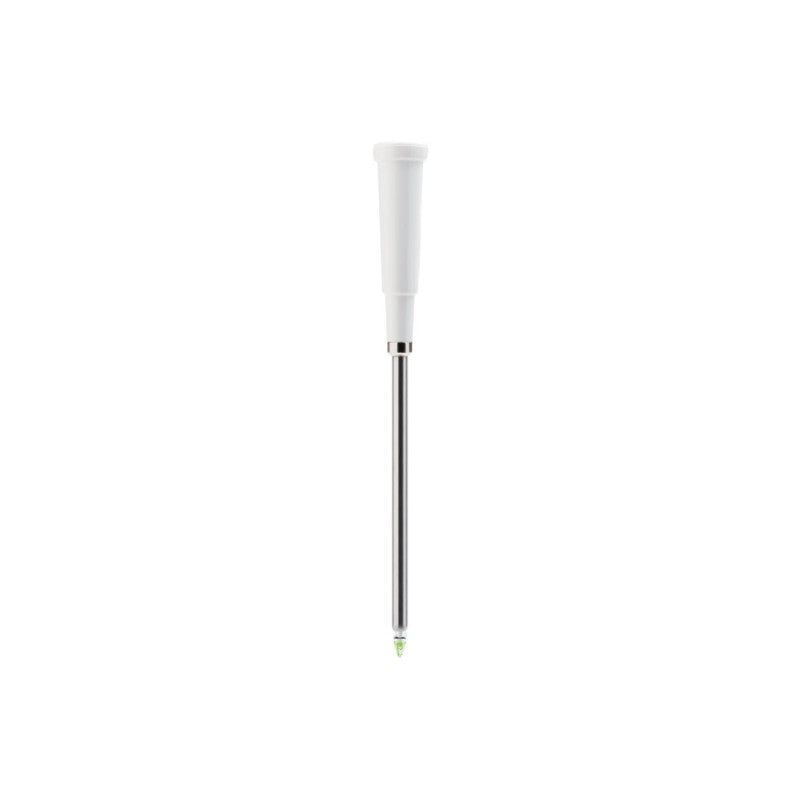
Hanna Instruments FC242D pH Electrode for Cheese Analysis
The FC242D pH electrode with internal temperature sensor is specifically designed for cheese analysis and for use with the HI-99165 pH meter.
Conical tip shape
- This design allows for penetration into solids, semi-solids, and emulsions for the direct measurement of pH in cheese products.
Key Features
- Stainless steel body
- Built-in temperature sensor
- Conical glass tip
AISI 316 stainless steel body
- The metal body offers durability in the production facility and can withstand chloride concentrations that cause corrosion in other types of way
Viscolene electrolyte
- The viscolene electrolyte offers a hard gel interface between the inner electrode components and the sample being measured. The electrolyte is silver-free for use in cheese products and is maintenance free too.
Single ceramic junction
- A porous ceramic frit allows the silver-free electrolyte to flow slowly into solution, providing accurate readings for aqueous samples.
Built-in temperature sensor
- A thermistor temperature sensor is in the tip of the indicating pH bulb. A temperature sensor should be as close as possible to the indicating pH electrode in order to compensate for variations in temperature.
Low temperature glass
- The FC242D electrode uses low Temperature (LT) glass for the sensing bulb. The LT glass tip is a lower resistance glass formulation. As the temperature of the sensing glass decreases, the resistance of the LT glass will increase approaching that of standard glass at ambient temperatures. The FC242D is suitable to use with samples that measure from 0 to 50°C.
Specifications
| Description | pre-amplified pH/temperature probe |
| Reference | single |
| Junction | ceramic |
| Electrolyte | viscolene |
| Max Pressure | 0.1 bar |
| Range | pH: 0 to 12 |
| Recommended Operating Temperature | 0 to 50°C - GP |
| Tip/Shape | conical |
| Temperature Sensor | yes |
| Amplifier | yes |
| Body Material | AISI 316 stainless steel |
| Cable | coaxial; 1m |
| Connection | DIN |
Frequently Asked Questions
Clear answers to help you choose the right water testing solution with confidence
Which brands of water testing kits do you supply?
Do you provide kits for both home and professional use?
Yes — whether you’re a pool or spa owner, aquarium keeper, utility company, or a university laboratory, we have the right solution for your needs.
Can I arrange servicing or calibration for my photometer?
Absolutely. We also provide servicing and calibration to keep your photometers accurate and reliable.
How quickly do you dispatch orders?
Orders placed before 2:30 pm (Monday–Friday) are dispatched the same day. We also ship on Saturdays for your convenience.
Which couriers do you use for delivery?
We deliver through UPS, DPD, and Royal Mail. You can also choose to upgrade to next-day delivery at checkout.
What is your return policy?
We accept returns within 14 days of delivery provided the items are unused, in their original packaging, and in resalable condition. Please contact our team before returning any items.
Can I place bulk or business orders?
Yes, we welcome bulk, trade, and institutional orders. For tailored pricing or large quantities, please get in touch with us directly.
How can I get help if I’m unsure which kit to buy?
You can call us at 📞 +44 (0)115888 2726 and our team will guide you in choosing the most suitable kit for your needs.